

What if the powder or spray that seems to work is only masking an odor that will return? Choosing an odor absorbing carpet treatment Seattle homeowners can rely on starts with considering whether the smell is coming from the carpet, the padding, or somewhere else. It’s frustrating when a fresh scent fades and the problem comes back, especially in a home with children or pets.
This guide explains the difference between absorbing, masking, and treating odors, and how to choose a next step based on the likely source and how long the smell persists. You’ll learn when a surface treatment may help and when deeper cleaning is worth considering. For persistent carpet odors, Anderson Carpet & Tile Cleaning assesses the carpet during a walkthrough, uses truck-mounted steam extraction, and offers specialized enzyme treatments for organic pet odors and stains. The company uses eco-friendly, non-toxic cleaning solutions that are safe for children and pets.
Key Takeaways
- Distinguish absorption from fragrance masking and source removal to set realistic expectations for a treatment.
- Use the odor’s likely source, location, and persistence to choose a suitable next step, from a surface approach to deeper cleaning.
- For homes with children or pets, consider both the treatment directions and whether the approach addresses the underlying odor.
- If odors return or surface treatments aren’t working, a professional walkthrough can help match cleaning to the carpet’s condition.
Seattle Odor-Absorbing Carpet Treatment: Can & Cannot Do
An odor-absorbing treatment is intended to capture or reduce odor compounds, rather than simply add a pleasant scent. That differs from fragrance masking, which covers an unpleasant smell temporarily, and source removal, which targets the material causing it. A persistent odor may be held in the carpet fibers, may have reached the padding, or may come from organic residue such as a pet accident. Lasting odor control depends on addressing the source, not simply changing the scent of the room.
How to tell a temporary carpet deodorizer from a source-focused treatment
Look at what a method is designed to do, not how strongly it smells after application. A fresh scent can make a room seem cleaner, but it doesn’t show that the original odor source is gone. Carpet construction and cleaning approaches vary; the overview of Carpet Cleaning Methods provides general context for how methods differ.
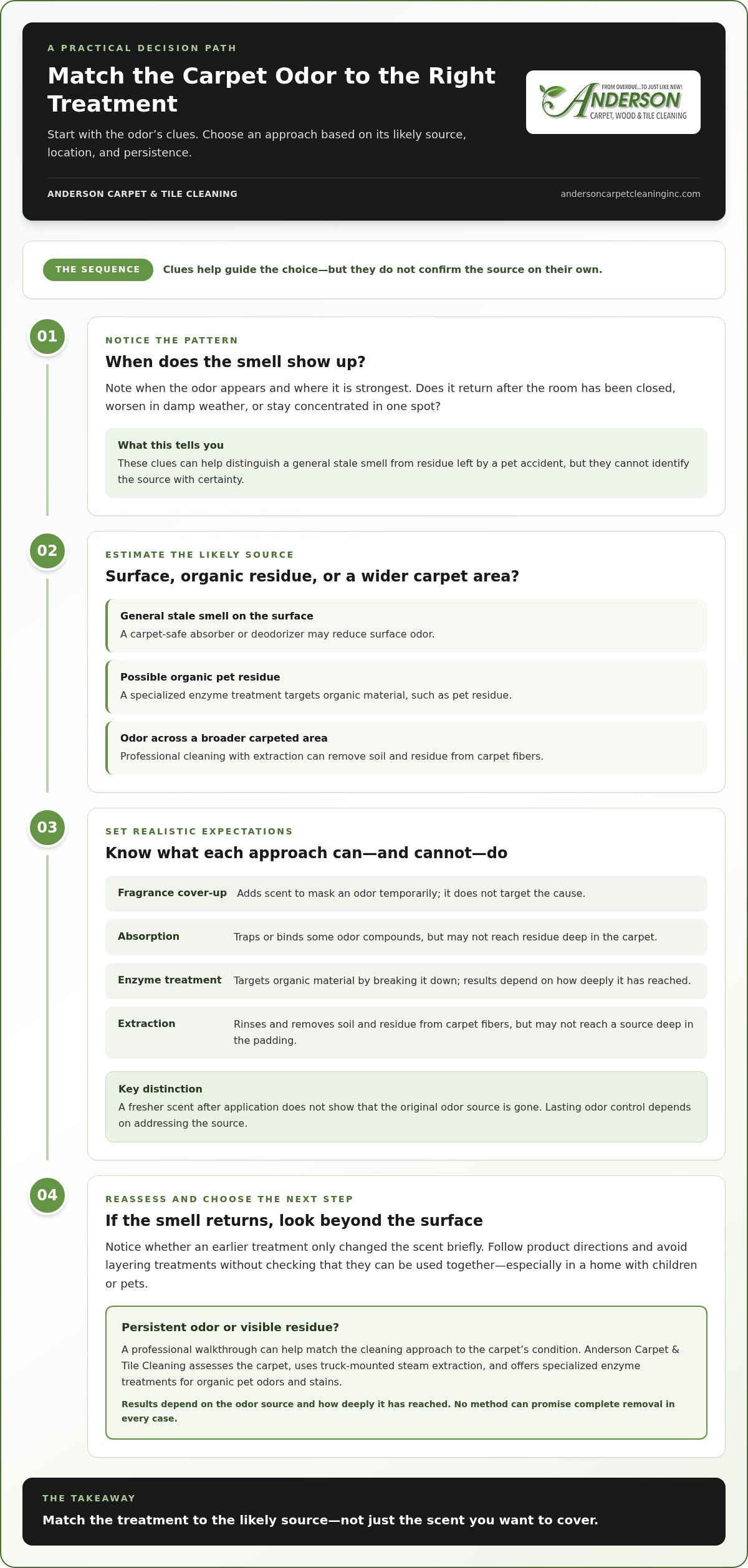
- Fragrance cover-up: Adds scent to mask an odor, but doesn’t target its cause.
- Absorption: Traps or binds some odor compounds, but may not reach residue deep in the carpet.
- Enzyme treatment: Targets organic material, such as pet residue, by breaking it down.
- Extraction: Rinses and removes soil and residue from carpet fibers, but may not reach a source deep in the padding.
For an odor absorbing carpet treatment Seattle homeowners can choose with clearer expectations, first consider where the smell may be coming from and whether it returns after the carpet dries. A general stale smell and an organic pet odor may call for different approaches. No method can promise complete removal in every case; results depend on the source and how deeply it has reached. If a surface product changes the scent only briefly, consider a treatment that addresses the underlying residue.
How to Choose a Carpet Odor Treatment in Seattle
Start by noting when the smell appears and where it’s strongest. Does it return after the room has been closed, worsen in damp weather, or stay concentrated in one spot? These clues can help distinguish a general stale odor from residue left by a pet accident. They won’t confirm the source on their own, but they can help you choose a sensible treatment category.
Which carpet odor treatment fits the problem?
Match the approach to the likely source and keep expectations realistic. A fragrance may freshen the room without treating residue, while an absorber may help with some surface odors. Persistent organic pet odors may call for specialized enzyme treatment rather than fragrance alone.
| Likely odor source | Treatment category | Realistic expectation |
|---|---|---|
| General stale smell on the surface | Carpet-safe absorber or deodorizer | May reduce surface odor; reassess if it returns. |
| Organic pet residue | Specialized enzyme treatment | Targets organic material; results depend on how deeply it has reached. |
| Odor across a broader carpeted area | Professional cleaning with extraction | Can remove soil and residue from carpet fibers; deeper sources may need assessment. |
Before applying a product, note whether the odor is limited to one area or spread across the room, and whether earlier surface treatments only changed the scent briefly. Follow the product directions and avoid layering treatments without checking that they can be used together, especially in a home with children or pets. If pet residue seems likely, a specialized pet odor treatment may be more suitable than fragrance alone.
For a persistent smell, a walkthrough can help match the cleaning approach to the carpet’s condition. Anderson Carpet & Tile Cleaning serves Seattle and the Eastside, including Bellevue, Redmond, Woodinville, Medina, and Federal Way. Its service includes truck-mounted steam extraction and specialized enzyme treatments for organic pet odors and stains. Learn more about carpet cleaning in Seattle.
When Professional Carpet Odor Treatment in Seattle Makes Sense
A professional assessment makes sense when an odor keeps returning after surface treatments, residue is visible, or the smell is concentrated in a spot that may have absorbed a spill. Adding more powder or fragrance can change the scent temporarily without resolving what remains in the carpet. If the odor persists, an odor absorbing carpet treatment Seattle homeowners choose should start with understanding the carpet’s condition and the likely source.
Matching the treatment to the odor source helps set realistic expectations and gives cleaning a better chance of addressing the problem.
What Seattle homeowners can expect from a professional cleaning visit
The visit begins with a walkthrough to assess the carpet and discuss the odor. That helps tailor the cleaning approach to the carpet’s condition. Anderson Carpet & Tile Cleaning uses truck-mounted steam extraction with a high-temperature rinse, followed by moisture extraction to remove cleaning moisture and loosened soil from the carpet. The process focuses on cleaning the carpet rather than relying on fragrance to cover a smell.
Anderson Carpet & Tile Cleaning uses eco-friendly, non-toxic cleaning solutions that are safe for children and pets. For organic pet odors and stains, specialized enzyme treatments target the organic residue. As with any method, results depend on the odor source and how deeply it has reached. The Seattle carpet-cleaning guide offers more detail on professional extraction.
If recurring odors are making it hard to enjoy a fresh-feeling room, explore local carpet cleaning in Seattle from a company serving Greater Seattle and the Eastside.
Choose a Clear Next Step for a Fresher Home
Let the smell guide your next move. If it returns after a surface treatment, pause before adding more fragrance and consider whether the carpet needs a closer assessment. Choosing an odor absorbing carpet treatment Seattle homeowners can feel confident about begins with a practical goal: address the likely source while keeping your household’s needs in mind.
Anderson Carpet & Tile Cleaning is a woman-owned, family-operated local business serving Greater Seattle and the Eastside, including Seattle, Bellevue, Redmond, Woodinville, Medina, and Federal Way. Its carpet cleaning combines truck-mounted steam extraction with eco-friendly, non-toxic solutions that are safe for children and pets. For a practical next step, explore professional carpet cleaning in Seattle.
Frequently Asked Questions
Does odor-absorbing carpet treatment remove the source of the smell?
Not necessarily. An odor absorber may reduce smells it reaches, but it won’t always remove residue embedded in carpet or padding. If you’re considering an odor absorbing carpet treatment in Seattle, check the product’s intended use and directions, then notice whether the smell remains after the product is removed or vacuumed up. A lingering odor may mean the source needs further attention.
Is odor-absorbing carpet treatment safe for pets and children?
Safety depends on the product and how it’s used, so read its label and follow directions carefully. Keep children and pets away from treated areas for the period specified, and store powders or sprays where they can’t reach them. Anderson Carpet & Tile Cleaning uses eco-friendly, non-toxic cleaning solutions that are safe for children and pets.
How do I know whether carpet odor needs professional treatment?
Consider a professional assessment if the smell persists after you’ve followed a product’s directions, covers a broad area, or comes with visible residue. In Seattle-area homes, also pay attention if the odor seems to come from beyond the carpet, such as a nearby upholstered item or another part of the room. Identifying the affected area helps guide the next step.
Can carpet odor return after a treatment?
Yes. Odor can return if the original source remains, if it has reached the carpet padding, or if a new spill or accident occurs. A scent that reappears after the room has been closed for a while is a reason to reassess rather than repeat the same surface treatment. Note where and when it returns to help narrow down the cause.


